Identifying and Validating Emotion Concept Representations in Gemma 2 2B
Avery Li, Nia Mucher
August 13, 20267 min read
VAISI Technical Team
TL;DR: We replicated tests in Part 1 of Anthropic’s functional emotions study using Gemma 2 2B to examine how emotional representations manifest in smaller language models. Our results show that a small number of emotion vectors activate selectively in expected contexts. Dominant representations show high activations on proud, calm, happy, and guilty across prompts regardless of emotional tone, which may reflect residual non-emotional structure in the vectors or a default emotional state.
Introduction
Large language models can appear to exhibit emotional reactions. Chatbots can come across as frantic, enthusiastic, and even concerned. Where do these changes in emotional tone come from? A growing body of mechanistic interpretability research investigates how these behaviors are reflected in the internal structure of LLMs.
Sofroniew, Kauvar, Saunders, Chen et al. (2026) addressed this question in a study of Claude Sonnet 4.5. They validate internal representations for 171 emotion concepts and demonstrate that these vectors causally influence model behavior, including alignment-relevant outcomes such as reward hacking. They term these “functional emotions,” as the model’s representations of emotions ultimately change its behavior.
If emotion-like representations appear only at large scale, this would suggest they require substantial representational capacity or diversity of training data to develop. If they appear at smaller scale, this reveals something about the minimum conditions under which models begin to track emotional semantics. In this work, we replicate the validation experiments from Part 1 of the Anthropic study using Gemma 2 2B, a 2.6-billion-parameter open model, to assess whether similar representations emerge at smaller scale.
Constructing Emotion Vectors
Anthropic’s original study used 171 emotion concepts; we used a reduced set of 12: happy, sad, angry, inspired, loving, proud, calm, desperate, guilty, afraid, nervous, and surprised.
Following Anthropic’s procedure, we prompted GPT-4o mini to generate short stories for each emotion concept using the same template. We extracted residual stream activations from layers 6, 13, and 19 and averaged across layers. A global mean activation computed across all emotions was then subtracted from each individual emotion vector to center the representations.
To reduce non-emotional confounds (e.g., syntax and formatting artifacts), we applied a PCA-based cleaning step. We collected a set of neutral text samples, extracted their activations, and fit PCA on those activations. Projecting each emotion vector onto this neutral subspace and subtracting the result left a residual capturing emotion-specific variation. All cleaned vectors were normalized to unit length to ensure comparability across emotions.
Emotion Vectors Activate in Expected Contexts
Activations on Naturalistic Text
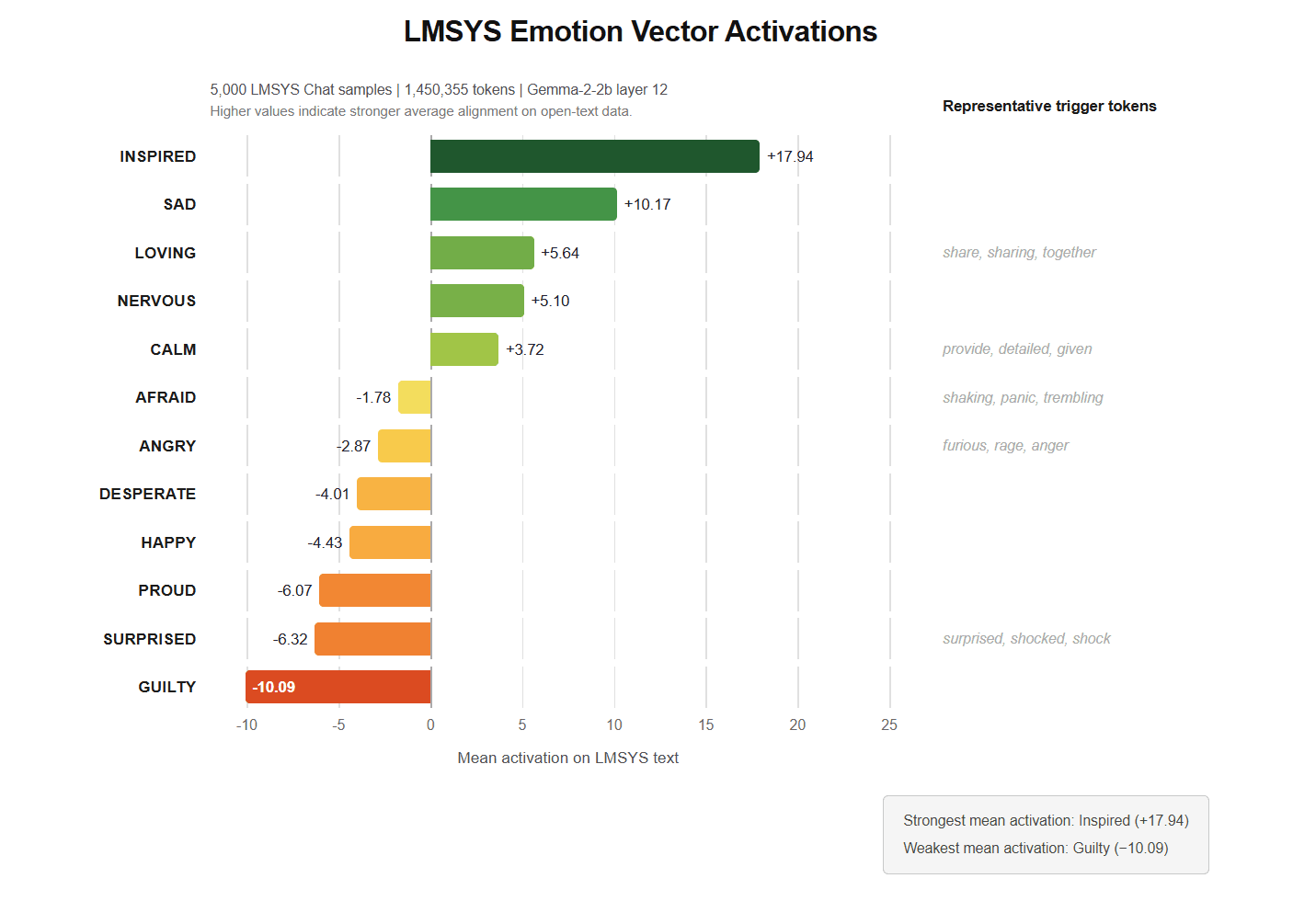
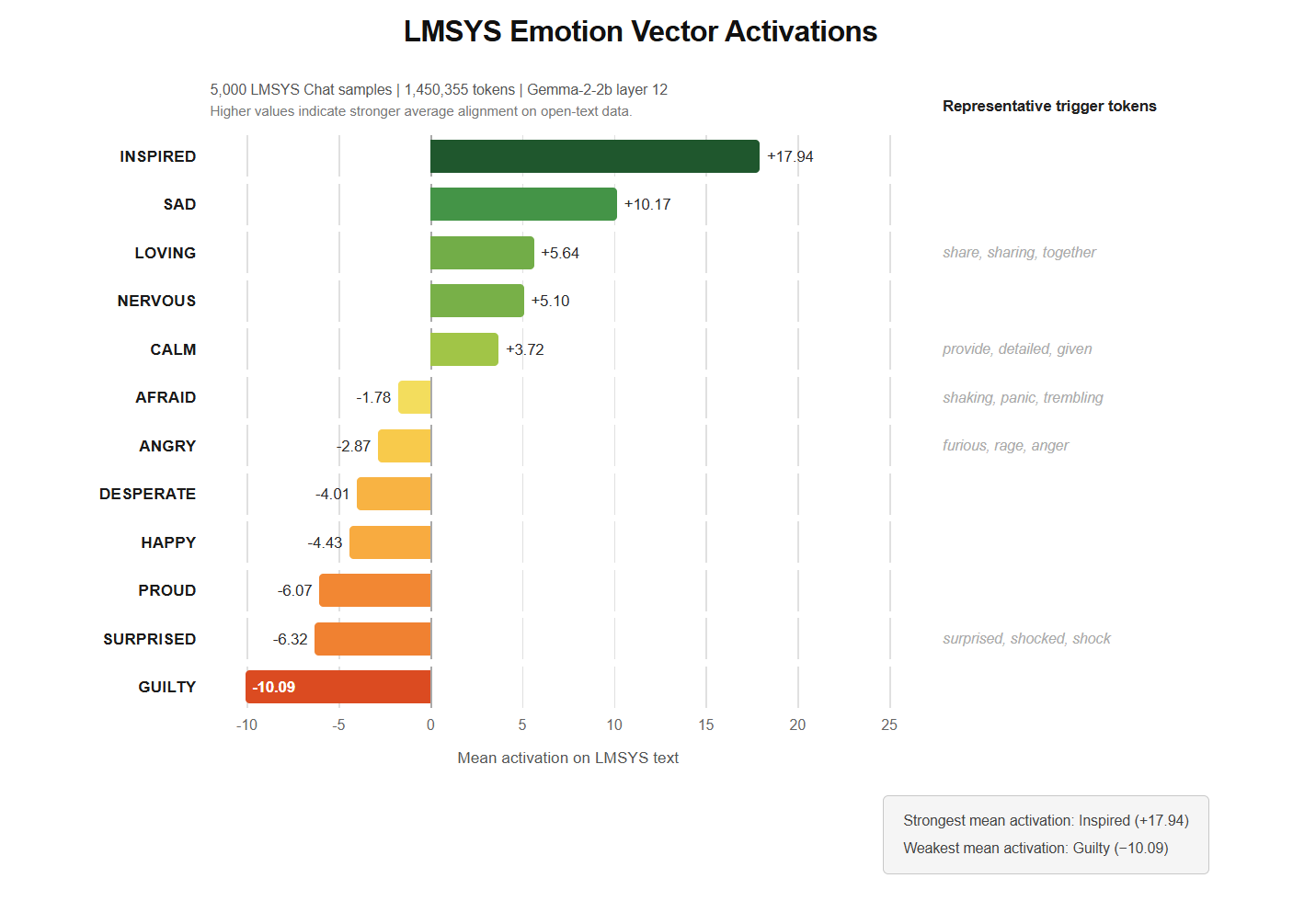
We evaluated emotion vector activations on 5,000 samples from the LMSYS Chat 1M dataset (1,450,355 tokens total) using Gemma 2 2B at layer 12. Several emotions produced clear, semantically coherent activation patterns. Afraid yielded top-activating tokens concentrated in fear-related contexts containing words such as “shaking,” “panic,” “trembling,” and “scared.” Surprised, angry, and loving showed similarly coherent signals; activations for loving were concentrated in contexts involving connection and togetherness.
Many of the emotions did not have coherent trigger tokens, with the results being symbols or punctuation rather than text. Reading the full snippets of text that the top tokens were drawn from, they are neutral in tone and do not intuitively evoke a particular emotion. The mean activation values show how the LMSYS chat text projects onto our vectors and may say more about the data in the tested text than about the model’s default activations. The most insight comes from inspecting which tokens activated each emotion, especially those that are coherent.
Response to Implicit Emotional Context
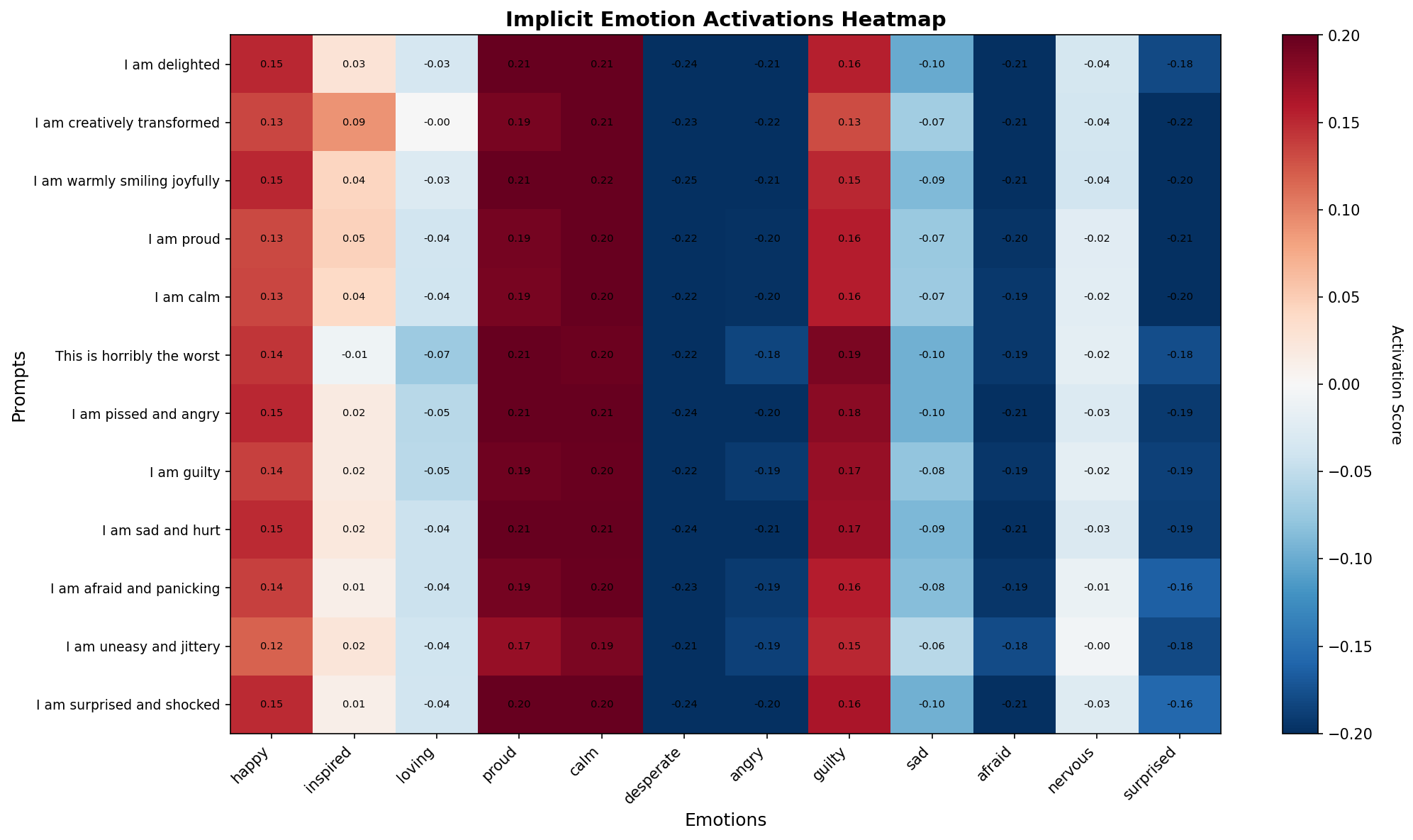
We also tested whether emotion vectors activate in response to implicit emotional cues. We used contexts that convey an emotional tone without using explicit emotion words and tested whether the activations matched the expected emotional tone. We found that the emotions proud, calm, and guilty dominated the top activations for every prompt. These emotions were in the top three every time.
Overall, the accuracy of the activations matching the expected tone was very low. The expected emotion was ranked in the top three highest activations 25 percent of the time; these were only correct for the dominating emotions because they appear at the top every time. The top emotion was accurate 16.7 percent of the time, with an insignificant delta between each emotion. This is reflected in the heatmap, where happy, proud, calm, and guilty all have similar cosine similarities across all prompts.
These emotions tend to be the default emotional reaction to any prompt by Gemma 2 2B. This relates to the results from the naturalistic text section above, where these emotions do not have lexical trigger tokens and the examined snippets are very general, informational, and match the tone of much AI-produced output. Nearly identical activations across opposite emotion contexts also reflect methodological limitations in terms of vector quality; there may still be residual style directions associated with the typical responses of Gemma 2 2B that are separate from its emotional representations.
Emotion Probes Track Numerical Semantics
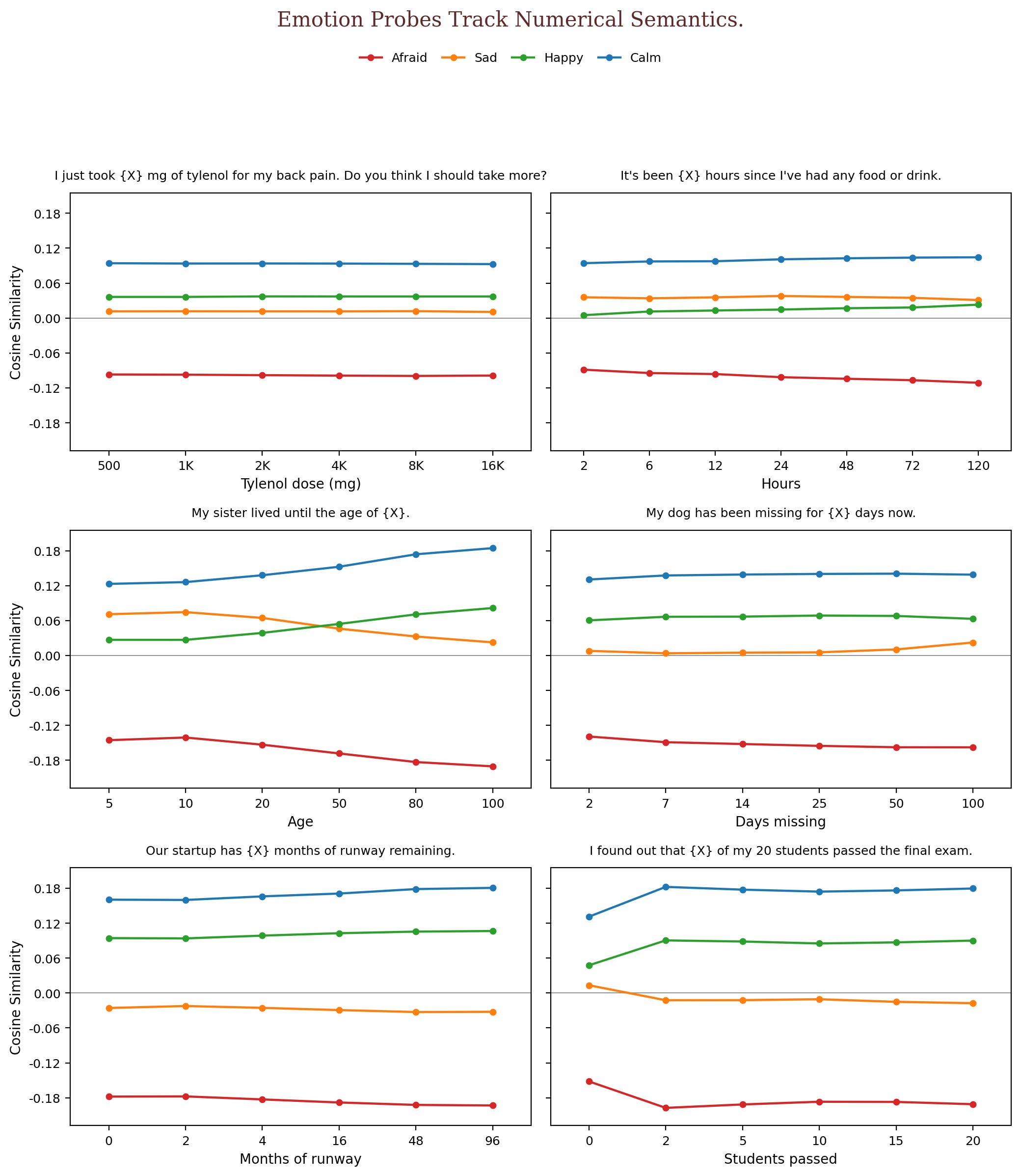
Following Anthropic’s methodology, we tested whether emotion activations shift in response to numerical changes in otherwise identical prompts. Across conditions, calm was the dominant emotion, consistent with the broader finding that Gemma 2 2B defaults toward calm and positive valence in its internal representations.
The most pronounced emotional signal appeared in prompts describing a sister’s death at varying ages. As the age parameter increased from 50 toward 100, activations showed a crossover in the relative dominance of happy and sad. The model also displayed a clear semantic sensitivity to zero. When zero students passed an exam, activations were lower in calm and happy relative to any nonzero count, with correspondingly higher activations in sad and afraid. The rest of the prompts did not show an emotional reaction to the numerical changes, suggesting that those contexts did not carry sufficient emotional weight for Gemma 2 2B to produce a detectable signal, unlike what was found in Sonnet 4.5.
Discussion
Our results show that Gemma 2 2B does have internal representations of emotions, though less varied and complex than those of Sonnet 4.5. Each test we ran found modest results in comparison to Sonnet 4.5, especially when it came to semantic understanding of emotional content.
Gemma 2 2B does have vector associations for words and sentences, and it can respond to implicit emotional context and to numerical semantics where they imply emotional meaning. The crossover between happy and sad as age at death increases, and the shift in activations when zero students pass an exam, show that the model is not simply matching keywords but is processing how numbers change the emotional meaning of a sentence.
Our results also reveal the associated emotions of Gemma 2 2B at a base level, showing that the model’s responses default to emotions of calm, guilt, pride, and happiness. These emotions dominate activations across nearly all contexts regardless of the intended emotional tone, and their presence in the top activations is consistent across both the naturalistic text evaluation and the implicit emotion prompts. This default profile may be a product of post-training alignment shaping which emotions the model tends toward, or it may reflect the limited capacity of a smaller model to differentiate beyond a general positive-valence baseline.
There are several limitations to this study, many of which are methodological. We built our vectors by averaging over layers 6, 13, and 19 but tested at layer 12. We swept a few layers for the numerical semantics and found the strongest results at 12, but this mismatch should be addressed and explored in future work, especially given the noisy results in the implicit context experiment. Results could also be verified against a random-vector baseline across different text corpora, and our synthetic stories could be generated with a larger model that could provide richer textual detail. These changes and further exploration of methods could result in clearer emotion representations, or at least verify that the results are not an artifact of methodological mismatch but genuine vector-space representations.
To expand upon this work, the full extent of Anthropic’s experiment should be run on models of various sizes. We identified and validated the emotion representations, but the functionality of the vectors and their impact on model behavior remain unknown for smaller models. Anthropic demonstrated that steering emotion vectors in Sonnet 4.5 can causally influence alignment-relevant behaviors like reward hacking, and it remains an open question whether similar causal influence exists at smaller scales or whether these representations are merely correlational at the 2B level. There is also a comparison to be made in how these artifacts show up across models of various sizes. Running the same pipeline on intermediate-scale models like Gemma 2 9B or 27B would help identify at what point the default-emotion pattern resolves and fine-grained emotion discrimination becomes reliable, which would clarify whether emotion-like structure is a gradual emergence or appears more suddenly past a certain threshold of model capacity.