What Armenia’s Tech Emergence Can Teach Us About Compute Diplomacy
Hovsep Seferian
April 28, 20269 min read
AI Governance Fellowship · Spring 2026
Armenia’s upcoming elections will be compute diplomacy’s first real test, revealing the geopolitical weight of international AI investment as a rival to traditional drivers of global alignment. After a $4 billion AI data center investment from the US government and Nvidia, the June 7 decision between the incumbent, pro-West Civil Contract party and its pro-Russian opposition will determine whether international AI investment, or “compute diplomacy,” can create dependencies durable enough to shape alliance commitments. Compute diplomacy is becoming a new geopolitical tool – one that the United States is strategically employing through its successful compute-power manufacturers to pressure adversaries, build dependence on American infrastructure, and shape the international order: one that the Armenian AI experiment can illuminate for the rest of the world.
Firebird Deal
On June 11, 2025, Nvidia announced a $500 million partnership with American-Armenian AI startup Firebird and the Armenian government to bring the first large-scale AI data center to the Caucasus – a 100-megawatt facility which received US government approval to run on AI servers from Dell Technologies. On February 9, during a visit to Armenia’s capital Yerevan, Vice President JD Vance announced that the second phase of the investment would scale to $4 billion and provide 41,000 more Nvidia Blackwell GB300 GPUs to Armenia in addition to the original 9,000. The sheer amount of compute power solidifies “Armenia as home to one of the world's top five largest AI GPU clusters.” This move is the latest in technological innovation between the Trump Administration and Prime Minister Nikol Pashinyan’s government, coming less than a year after three Memorandums of Understanding were signed between the two nations. These agreements promised further cooperation on energy, economy, and security, which Pashinyan credited as “bringing to life” the Firebird project.
Compute Diplomacy in Action
In the Trump Administration’s 2025 AI Action Plan, its objectives were made very clear: “to achieve global dominance” in the AI space. The plan explicitly outlines Washington’s intentions to build “America’s AI alliance,” to use AI to “keep countries from turning to [America’s] rivals,” and to prevent US allies from becoming “dependent on foreign adversary technology.” Before the plan’s release, Nvidia chip deals were announced with Qatar, the UAE, and Saudi Arabia, on Donald Trump’s tour of the Persian Gulf, pioneering a new era of “compute diplomacy.” Compute diplomacy is the leveraging of access to AI compute power (infrastructure, chips, etc.) to shape states’ geopolitical alignment and commitments. Washington’s newest diplomatic instrument has already frozen China out of AI infrastructure in the UAE and Saudi Arabia, as deals with both nations for Nvidia chips followed pledges to eliminate Chinese hardware from technology environments, divest from Chinese companies, and promises to “firmly anchor” technology systems with the US and its corporations and invest hundreds of billions of dollars into the United States.
Compute Diplomacy in Armenia
Now, during a crucial election period, the Armenian case marks the beginning of this strategy being deployed as a play for influence in the backyard of a historic great power – Russia. The fact that this strategy includes Armenia is telling – as Russia’s grip on the nation slips, the Trump Administration sees an opening for a Western wedge in the Caucasus that wasn’t there before. Washington’s compute diplomacy in Yerevan reflects a broader geopolitical strategy: access to AI infrastructure is beginning to rival traditional security or economic commitments as a driver of alignment.
Traditionally seen as part of Russia’s sphere of influence, Armenia’s pull to the West has continued in recent years under Pashinyan, who has pursued accession to the European Union, signed a Strategic Partnership Agreement with the United States, and paused membership in the Russia-run Collective Security Treaty Organization (CSTO) over concerns about Russian inaction during and after the Second Karabakh War. Pashinyan has also welcomed US involvement in both infrastructure and security with the Trump Route for International Peace and Prosperity set to cut through southern Armenia and now Firebird’s data center being constructed in Gyumri, Armenia.
On April 1, Russian President Vladimir Putin and Pashinyan clashed over these policies during a meeting in the Kremlin. As Armenia’s relationship with Moscow continues to strain, the nation heads into its parliamentary elections on June 7, which promise to be a referendum on the geopolitical “pivot-point” Armenia finds itself at. Pashinyan’s Civil Contract Party faces competition from two main blocs, the Strong Armenia and Armenia Alliance parties, both of which have strong ties to Russia. Though there hasn’t been rhetoric of reneging on the Firebird deal, some prominent opposition figures have personal and financial connections to Moscow, are far less open to a Westward transition, and are more likely to prioritize a relationship with Moscow over one with Brussels or Washington. The Trump Administration and Nvidia’s investments signal the arrival of artificial intelligence as a Western geopolitical tool in the Caucasus and post-Soviet sphere and push the boundaries of what achieving “compute sovereignty” can mean for a nation and its global strategic position.
The US and Nvidia’s investment spree, which has spanned the Middle East and 20 different service providers in Europe, has been turning compute power into geopolitical and diplomatic leverage in line with the Trump Administration’s 2025 AI Action Plan. The desire for compute sovereignty, or the perceived need to “secure sufficient access to AI compute for domestic firms, public sector organizations, and/or researchers,” has only increased in the last few years due to “many governments see[ing] AI as a potential source of national economic, military, and/or cultural advantage.” This scramble for AI power, and American willingness to spend for it, has allowed the United States and powerhouse corporations like Nvidia to open doors to further cooperation on a number of issues, like border security against Azerbaijan and energy cooperation in Armenia’s case. It also has allowed Washington and Silicon Valley to flex soft power muscles and redraw the map by giving them a platform to make signals about international economic and security commitments. During the 2025 GTC Summit in Paris, Nvidia CEO Jensen Huang presented Firebird and, by extension, Armenia, as a “European” firm, even though Armenia wasn’t even visible on the map of Europe that accompanied the presentation.
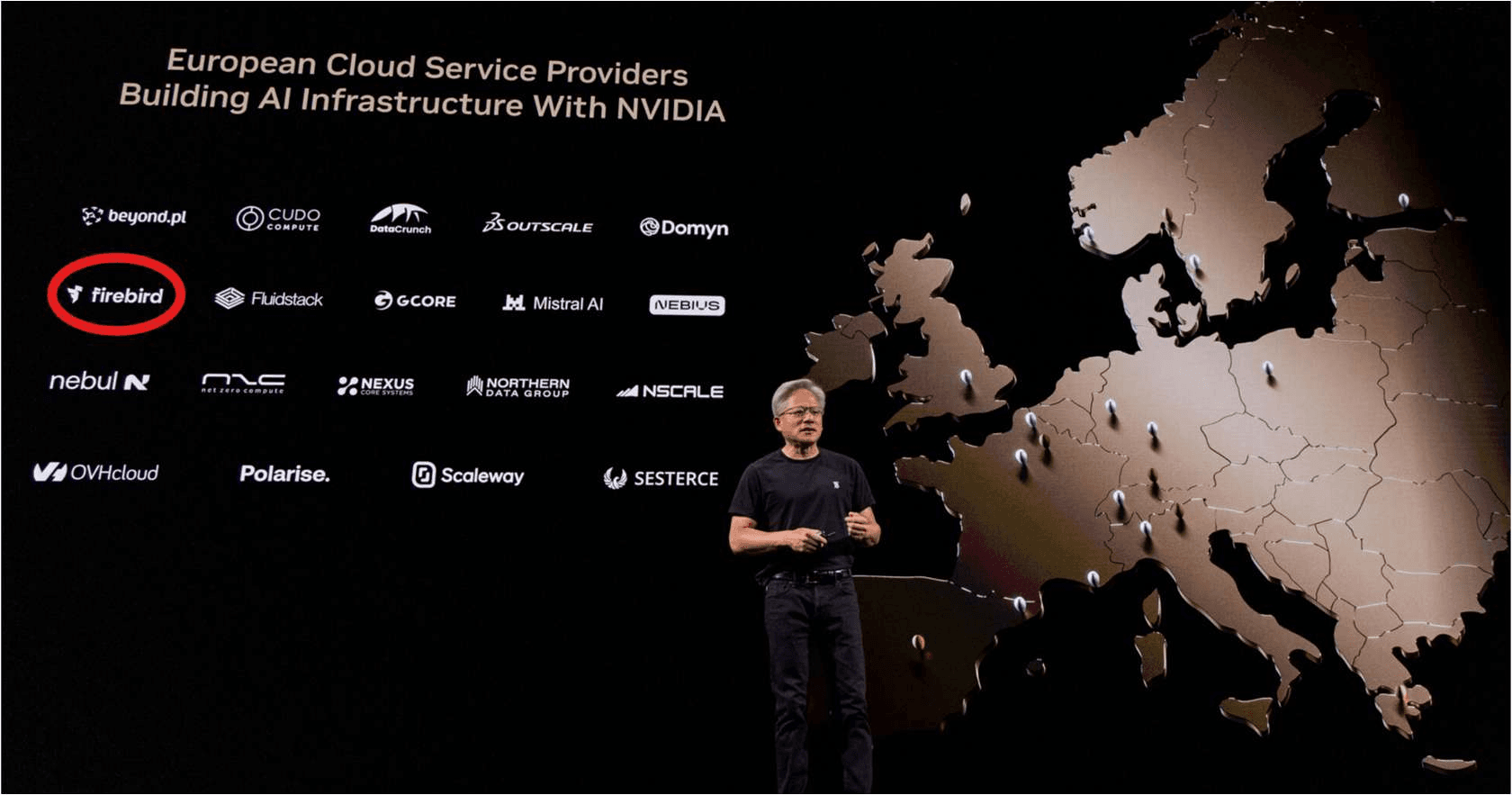
These kinds of signals indicate a new arena for great power competition, and a new way for nations to stake claims in the world order. The US is treating Armenia as a Western foothold in Eurasia, and committing itself to Armenia’s security beyond just its words: in a world where Armenia’s critique of Russia was that they stood idly by during war with Azerbaijan, preventing the Gyumri supercenter from falling into less friendly hands makes Armenia’s security a much more salient issue for the White House.
Russia’s Role
Russia’s influence in the Caucasus has been in flux since the beginning of the new decade. With Georgia, once the Western golden child of the post-Soviet space, pulling back towards Moscow, and Armenia embracing American compute, security, and energy commitments, the political geography of the region is rapidly changing. Russia’s position as Armenia’s security guarantor already seemed doubtful after the Kremlin’s action during and after the Second Karabakh War, doubts that can only increase due to the costly war in Ukraine, the American arrival in Armenia, and even Armenian parliamentarians threatening to leave the CSTO entirely if Russia raises gas prices. Pashinyan’s government has made AI a large talking point, and should they lock themselves in with the United States and Nvidia, their desire for compute sovereignty may sway them further West than ever before. Analysts in America have hailed Armenia’s westward tilt as a “rare strategic opportunity,” but one that no doubt comes with major risks for the security of the technology and the investment, pending the stability of the nation and potential realignment with Russia. The Armenians have reasons to believe that they would be welcomed in Washington. The relationship between the United States and Armenia has been improving since Armenia’s inclusion on Trump’s Gaza “Board of Peace” alongside longtime rivals Azerbaijan, and a series of visits between Pashinyan and Trump have built an “everlasting friendship” between the two, according to the US President.
Policy Implications
As Washington develops its global AI position, questions arise about the intentions of this level of investment. Are Washington and Yerevan aligning, or are both hedging bets for economic gain? The regularity of relations between the two and the close relationship between Trump and Pashinyan point to a deliberate alignment between the US and Armenia, one that compute diplomacy has unofficially locked in by the sheer magnitude of the Firebird investment keeping the US committed to the physical and technological security of Armenia. Whether or not compute diplomacy can compete with Russia’s hard power in the region relies upon the continued integration of US AI infrastructure and technology into Armenia’s ecosystem. Keeping Armenia’s compute sovereignty reliant upon American support will be the key to the staying power of American technological influence in Armenia – transitioning from compute diplomacy to compute contingence, or the manufactured reliance on a great power for AI resources, can keep Armenia attached to America to reap technological benefits despite Russian pressure. Unlike other forms of economic interdependence, the specialization and technicality of AI infrastructure and supply chains makes pivoting away from the provider especially difficult – if compute diplomacy is in America’s future, the prioritization of policies that support global technological integration (such as Firebird’s Dell servers) will soon follow.
The more immediate issue for America’s AI campaign is whether compute diplomacy can be resilient to domestic political change. With the geopolitical alignment of their nation in their hands, the votes of the Armenian citizens play a large role in determining what the future of compute diplomacy looks like in the Caucasus and the post-Soviet world; a swing towards Russia in the upcoming parliamentary elections will test the elasticity of AI infrastructure’s political effects.
The Elections
With elections only a few weeks away, many Armenians are undecided on the right path forward. Even still, since the beginning of his Westernization policy, Pashinyan’s job approval has improved, and a majority of voters believe that his Civil Contract party is in a strong position to capture a single-party government. Additionally, a “majority of voters consider Armenia’s security environment to have improved,” even as bombs fly in neighboring Iran and Armenia’s relationship with its historic security guarantor falters. The United States and Nvidia saw a void and stepped into it, and other Eurasian nations will be watching with eager eyes as that pair and Armenia have already broken ground on the world’s newest AI supercluster. Kazakh President Kassym-Jomart Tokayev declared 2026 as being Kazakhstan’s “Year of AI.” Kyrgyzstan has taken steps to self-regulate its AI advances. Uzbekistan and Tajikistan have both made their AI aspirations clear as well. In a Eurasian tech ecosystem looking for funding and resources, the Trump Administration’s new policy of compute diplomacy will win them a lot of friends and put Russia in a difficult position vis-à-vis its neighbors.